Setting up a company in the UAE is the beginning of your entrepreneurial journey. Although you have achieved a great milestone by setting up the business efficiently, there are compliance requirements that must be ensured, monitored, and updated periodically. Many entrepreneurs mistakenly believe that there are no further compliance requirements once the trade license is issued. An entrepreneur must register for tax, renew the trade license, maintain proper financial records, and adhere to reporting protocols to remain in the game legally.
Let’s dive into the compliance requirements after company formation in the UAE. This detailed post will offer insights concerning compliance needs a business owner must track constantly. Delays and non-compliance can land your firm in trouble.
Significant changes have occurred in the compliance requirements over the years. Presently, in 2026, the regulations and compliance procedures have become more meticulously structured and stricter than in the past. Aiming to curb money laundering and prevent terrorist funding, the country has established a rigorous financial monitoring approach. Hence, in addition to maintaining a valid business license in the UAE, you must comply with all requirements, including annual corporate tax filing, annual audits, VAT returns, ESR compliance (if applicable), and UBO registry.
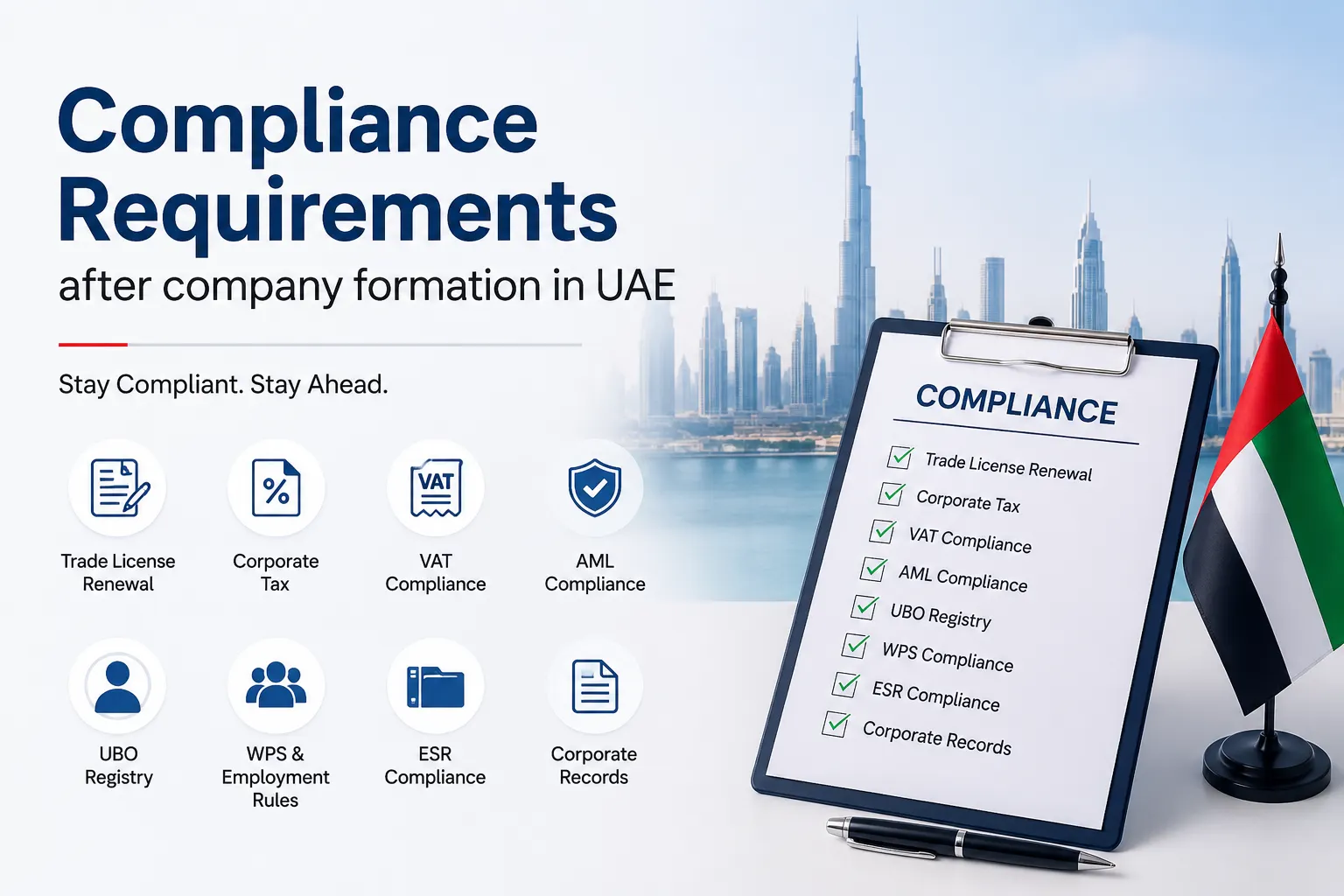
Key compliance requirements after company formation in the UAE are:
- Trade License – A trade license is generally valid for 12 months. The renewal process must commence at least 30 days in advance to avoid unwanted delays and late fees. Hiring Kiltons’ professionals would be beneficial in handling the activity professionally. You can focus on business operations while our team handles the complete process. The lease agreement for office space/flexi-desk and commercial space also have to be renewed before initiating the trade license renewal process. This would be the ideal time for obtaining amendment approvals. A company can amend operational and administrative aspects, including business activities, trade name, license type, business address, shareholders, and company structure. The compliance requirements are:
o Trade license renewal
o Ejari and lease agreement renewal
o Amendments (as required)
- Corporate Tax – Every company registered in the UAE must mandatorily comply with corporate tax. Register with the Federal Tax Authority and file a corporate tax return in the stated timeframe without fail. The tax filing is compulsory even if the profit earned is zero. Bookkeeping, auditing, and accounting records must comply with the extant policies. Companies must pay corporate tax at a rate of 9% for taxable income above AED 375,000 (if applicable). Qualifying Free Zone Companies can claim tax rebates based on Qualifying Free Zone Person (QFZP). The corporate tax becomes zero for an entity qualifying as a QFZP. The bullet points regarding corporate tax for a company in the UAE are:
o The business must register with the FTA.
o Every company, even if it hasn’t made any profit, must file the tax return.
o Financial statements and accounting/auditing records must be maintained properly.
o The company must pay 9% corporate tax on taxable income above AED 375,000.
o QFZP compliance is a must for Free Zone Companies claiming 0% tax benefit, compared to 9% by other companies.
o Heavy fines will be imposed if a company delays the corporate tax registration.
- VAT Compliance (if threshold crosses the limit) – Unlike corporate tax, VAT registration is not mandatory. All companies having a turnover above AED 375,000 must register for VAT. Under this, Value Added Tax at the rate of 5% is collected on taxable products. All invoices, tax records, and financial statements must be maintained for periodic and quick audits. File VAT returns quarterly. The points to remember are:
o All companies with a turnover exceeding AED 375,000 must register for VAT.
o 5% VAT must be charged on all the taxable products.
o Maintain invoices, accounting records, and audit reports.
o File VAT return quarterly.
- Trade License Renewal and Amendments – The trade license must be renewed annually. All documents associated with the firm also must be checked for validity and renewed. The office lease agreement, Ejari, and additional approvals (if any) must be renewed for the smooth operation of the company. We suggest you consider the amendment procedure along with the trade license renewal. By this, you can pursue both activities simultaneously. Amendments including trade name, business activities, shareholders, legal structure, and business address are permitted. The points here are:
o Annual trade license renewal (excluding in free zones where a multi-year trade license is available)
o Renewal of lease agreement and Ejari
o Company amendments
- Accounting, Auditing, and Bookkeeping – Financial records must be up-to-date all the time. Companies may use an in-house team or hire specialised auditing and accounting agencies in the UAE. Nevertheless, the financial data must be error-free and accurate. Meticulously maintain the financial data that includes income, expense, transaction records, and additional info (if any). Annual audits and annual compilation of financial records are vital. Some free zones mandate annual financial audits for trade license renewal. The points to remember here are:
o Proper financial records
o Data regarding income, expense, and bank transactions must be updated constantly
o Annual financial statements
o Annual audits (if applicable)
- Anti-Money Laundering Compliance – Every entity in the UAE must comply with AML regulations. AML compliance is most necessary, especially for trading and service companies. Register on the goAML portal (if applicable). goAML is the Financial Intelligence Unit under the UAE government. Registering in goAML confirms legal compliance with AML and Counter-Terrorist Financing (CTF) regulations. KYC records of clients must be maintained in compliance with AML regulations. Suspicious activities must be reported to authorities. High-risk businesses must appoint a compliance officer for AML and CTF compliance. The activities under this compliance are:
o Register on the goAML portal of the Financial Intelligence Unit (if applicable)
o KYC records
o Reporting of suspicious transactions
o Appointment of compliance officer for high-risk businesses
- Ultimate Beneficial Owner Registry (UBO) – UBO is the real person who owns, controls, and benefits from the business. It must be a human being, not another corporate entity. Every company in the UAE must maintain a UBO registry. Any changes to the Ultimate Beneficial Owner must be reported to the authority within 15 days.
o UBO is the individual who owns 25% or more of the stake or voting rights in the company.
o The individual must be screened for global sanctions and any such disciplinary measures.
o Individual details along with supporting documents must be submitted to the national/central UBO registry as stipulated by the law.
- Wage Protection System (WPS) and Employment Rules – The Ministry of Human Resources and Emiratisation (MoHRE) has implemented strict labour and immigration rules. Accordingly, employee salary must be paid through the Wage Protection System. This is an electronic salary transfer system that ensures transparency and clarity on the wages paid. The immigration rules necessitate that employee visas and work permits must adhere to the promulgated rules. The company must be registered with the MoHRE to confirm that visa and labour rules are being observed meticulously.
o WPS compliance by registering in the WPS launched by the UAE government.
o Registration with the MoHRE to process employee residence visas and work permits.
- Economic Substance Regulations (ESR) Compliance – Companies involved in relevant business activities such as insurance, leasing finance, and banking must submit an annual ESR notification. An annual ESR report needs to be submitted (if applicable). The ESR ensures transparency in financial transactions. Not complying with ESR requirements can lead to heavy fines depending on the financial implications.
o ESR Compliance is mandatory for business activities such as investment, fund management, banking, leasing finance, Intellectual Property, shipping, and insurance.
o Present ESR notification annually.
o If applicable, submit ESR report annually.
- Corporate Records – Companies in the UAE must mandatorily maintain data concerning directors, shareholders, and other responsible individuals. The compiled data should be stored in accordance with the data protection, privacy, and company laws. All such data should be verified for accuracy while storing and submitted to the UAE authorities. Inaccurate data or hiding of sensitive info can lead to penal actions.
o Collection of individual data of directors and shareholders.
o Compilation of the data in the prescribed format.
o Implementation of data privacy protection norms.
o Submission to the government authorities.
We reiterate that a trade license is not the end of compliance requirements. Companies in the UAE must undertake recurring compliance activities to avoid operational limitations and fines. The UAE has established a well-structured compliance process to ensure a streamlined procedure. However, we understand that multiple activities and business operations can overload you. Preoccupied investors often overlook post-formation compliance, resulting in punitive measures from the authority.
Considering the conditions, Kiltons has formed an exclusive team to support businesses with compliance requirements. Our team will handle all recurring and one-time compliance needs on your behalf. Freeing you from the load.
Do let us know how we can help you. Contact Kiltons for a free consultation now.
Find the article informative? Share with friends.


 Schedule for